


OVERLAND HIKE TRAINING GUIDE
This guide has been produced for the use of all Leaders, Scouts and Explorers who wish to participate in the Overland Hike and be involved in the Mid Sussex District Overland Hike training programme, it should also be used by parents, so that everyone participating fully understands what is involved. It will prove to be an invaluable document during the training programme and with the training open to all irrespective of if you plan to enter the Overland Hike it will help younger Scouts get prepared for the Mid Sussex Challenge Hike in May/June.
The Overland Hike is a 2-day hike competition often called the “Ultimate Challenge”; it is open to entry to teams of four Scouts or Explorers from East and West Sussex above the age of 12 years, the route is a secret with teams only made aware of the start on the Saturday and finish on the Sunday prior to starting on the Saturday morning.
The information within this document gives you a guide to what Mid Sussex District Scouts plan with regard training for the Overland Hike, including what the training involves, where we are going and what equipment you will need allowing you to fully prepare for the “Ultimate Challenge”, the training is led by the District team.
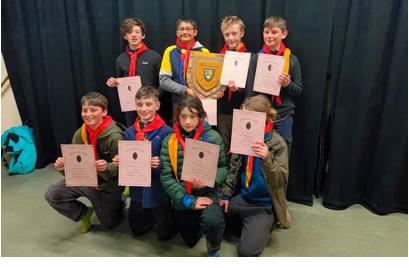
Historically Mid Sussex District have been pretty successful in the Overland Hike having one the Novice trophy three times and in 2023 the 5th Haywards Heath won and 1st Ditchling where 2nd and in 2026 we were 2nd both in the Scout Section (joint 5th Haywards Heath/5th Burgess Hill team) and in the Explorer section (Trident). This success has largely come about from our District training programme.
Rest assured participating in the Overland Hike is a great experience however, the thought of walking 20+ miles with a 10kg pack may sound daunting, but don’t worry, with training and some determination you can achieve it, we all must start somewhere and hopefully it will be a great experience.
The Overland Hike generally takes place the last weekend in March, our training programme begins in early January and runs through to the event itself, usually starting with an introductory hike starting in Mid-Sussex, after this training will be available most weekends up to the actual Overland Hike, locations will vary from East and West Sussex with a mix of checkpoints and simple hiking/map reading and while attending all the training sessions will prepare you better for the event we appreciate you may not have the time to come out every weekend.
To participate in the Overland Hike, you need to………………………………………….
Be prepared and have a team spirit
Some teams may be of experienced walkers, and some may be of Scouts/Explorers tackling the 1st Overland Hike however, by the end of the training whoever you are you will feel fit enough to complete the distance, have the Scouting skills and most importantly be a team of 4 who work together well and want to tackle the “Ultimate Challenge”.
MID SUSSEX DISTRICT OVERLAND TRAINING PROGRAMME
| Date | Start and Finish | Details |
| Training Hike 1 | Start/finish usually somewhere in Mid Sussex, usually a distance of about 6 miles. | Hike Open to all Scouts and Explorers, teams can be accompanied by leader/adult as required. |
| Training Hike 2 | Usually slightly longer up to 10 miles and using the South Downs more. | Hike Open to all Scouts and Explorers, teams can be accompanied by leader/adult as required. |
| Training Hike 3 | Starting on the Friday evening with about a 5-mile hike to a Scout HQ, overnight stay in Scout HQ with breakfast followed by another 8 miles on the Saturday morning, finishing about midday. | Hike Open to all Scouts and Explorers, teams can be accompanied by leader/adult as required and a chance to brush up on some map reading after dark. |
| Training Hike 4 | Usually slightly longer up to 12 miles and using the South Downs and the Weald so a bit more up and Down. | Hike Open to all Scouts and Explorers, teams can be accompanied by leader/adult as required. |
| Training Hike 5 | Full weekend practice in “Overland” conditions, including camping and cooking, 10 miles on the Saturday and 6 miles on the Sunday. | Teams hike in there 4 members as they will do on the Overland, the next best thing to the real event. |
| Training Hike 6 | Meet at Overland start, with extra training at a Scout HQ in Mid Sussex. | A visit to the start and finish locations followed by some incident training and equipment checks. |
| End of March | The Overland Hike | |
The District has a Facebook page called “Mid Sussex District Scout Hikes”, if you’re on Facebook it’s well worth joining as we post regular updates during weekend practice hikes keeping you up to date in how the teams are progressing.
Scouts/Explorers (and of course parents): When you get the training dates (they will be published on the District Diary and OSM) please put the dates in your diary and try and plan your weekends such that you’re available for as many training sessions as possible. Please note that the weather will have to be something special for a training session to be cancelled, you need to experience everything the UK weather can throw at you, in the last couple of years we have had rain, snow, fog and even the sun has been seen on the Overland Hike.
Leaders will more than likely be doing additional training as part of normal Troop evenings covering such things as knotting, first aid, stars and weather, cloud recognition, pioneering, survival, fire lighting all of which have come up as incidents on the Overland Hike.
EQUIPMENT
At the start of the Overland Hike, you will go through an extensive kit check by the organisers, rest assured if you haven’t got the correct kit you will not be allowed to start the hike. Your Troop will supply the team kit like tents, camping stove, map, compass, Hi Vis jacket but your personal equipment is also very important.
As I stated earlier in this guide we intend to train irrespective of the weather, so you need to get the clothing correct first, always wear multiple layers of clothing on the upper body as the air trapped between the layers is a good insulator and don’t forget the head, most heat loss is through you head so always wear a woolly hat and don’t forget those gloves, trust me there is no pleasure walking on the South Downs when your cold. For the lower body trousers must be long, loose fitting and can dry quickly, something made of cotton or polyester are best on no account wear jeans.
You will need some good quality waterproofs comprising waterproof jacket and trousers, the breathable variety are best but can be expensive ensure that what you use have taped seams, shop around, and don’t always go for the “named brands”.
You will need some good quality hiking boots that give ankle support, well-fitting and waterproof, as with waterproofs you don’t need the expensive brands but go for something that is a good fit but still within your budget. On no account turn up at the start with a new pair of boots, they might look new and clean, but they need “breaking in” before tackling 25 miles. Some Troops carry a stock of boots that have been given to the Troop as Scouts have grown out of them, this might be worth considering for the early training weekends.
Last of all you will need a rucksack of about 50ltr capacity capable of carrying up to 10kg comfortably, it should have padded shoulders and a waist strap which helps carry some of the weight on your hips. Despite what you might have heard rucks sacks are not waterproof, and you will need to line it, best thing to use is a rubble sack a simple dustbin liner is not strong enough and will soon get ripped.
PERSONAL KIT LIST
- Hiking boots.
- Woollen or cotton socks.
- Good quality waterproofs, top and trousers.
- Warm clothes, wear one or more t-shirts to give you the trapped air, go for polyester, cover with a long-sleeved shirt and then a fleece jacket. Long trousers as detailed earlier.
- Some spare warm clothes in your rucksack.
- A woolly hat and some gloves, preferably waterproof.
- A packed lunch and a drink, best to just go with water, include some chocolate; the sugar boost is always useful when the going gets a bit tough.
- A small torch will be useful.
- For the weekend camps you will be advised of what you need to bring along, i.e., sleeping bag.
A FEW FINAL TIPS TO HELP YOU GET THE BEST OUT OF THE TRAINING AND ULIMATLY ACHEIVE SUCCESS ON THE “ULTIMATE CHALLENGE”
- Try and come along to as many training sessions as you can, you might be active and participate in a lot of sport but walking 25 miles with a 10kg pack requires that little extra. The sessions will also help you improve your map reading skills and teamwork kills.
- Your feet are going to do most of the work in the Overland Hike so you need to take care of them by having suitable walking boots, a good pair of socks and if you do get blisters use the special blister plasters however, in the long term they will not be the answer, your feet need to get used to walking that little bit further than usual.
- Don’t think you’re not good enough, undertaking the training program we have put together will help you build the confidence to have a go, yes it will be tough but there is something special when you are called up at the finish to get you Overland certificate that shows you completed the “Ultimate Challenge”, you can be proud of the effort you and your team put in.
CONTACT/COMMUNICATION DETAILS
We will be using Online Scout Manager by using the event function within it. How will work? The District team will set up an event from within a District OSM Account. They will then share it with all Scout Troop’s and Explorer Unit’s OSM accounts. Leaders you will need to accept the invitation from within your troop’s or unit’s account and then invite your Young People to attend.
The training will be led by the District Leadership Team who have a vast experience in training teams for the Overland Hike, we will also have leaders available to walk with teams to receive extra training.
You can download the guide (this web page) and the rule book via the links below.
